Top 10 Hydraulic Goods Lift Manufacturers in Ahmedabad, Gujarat, India
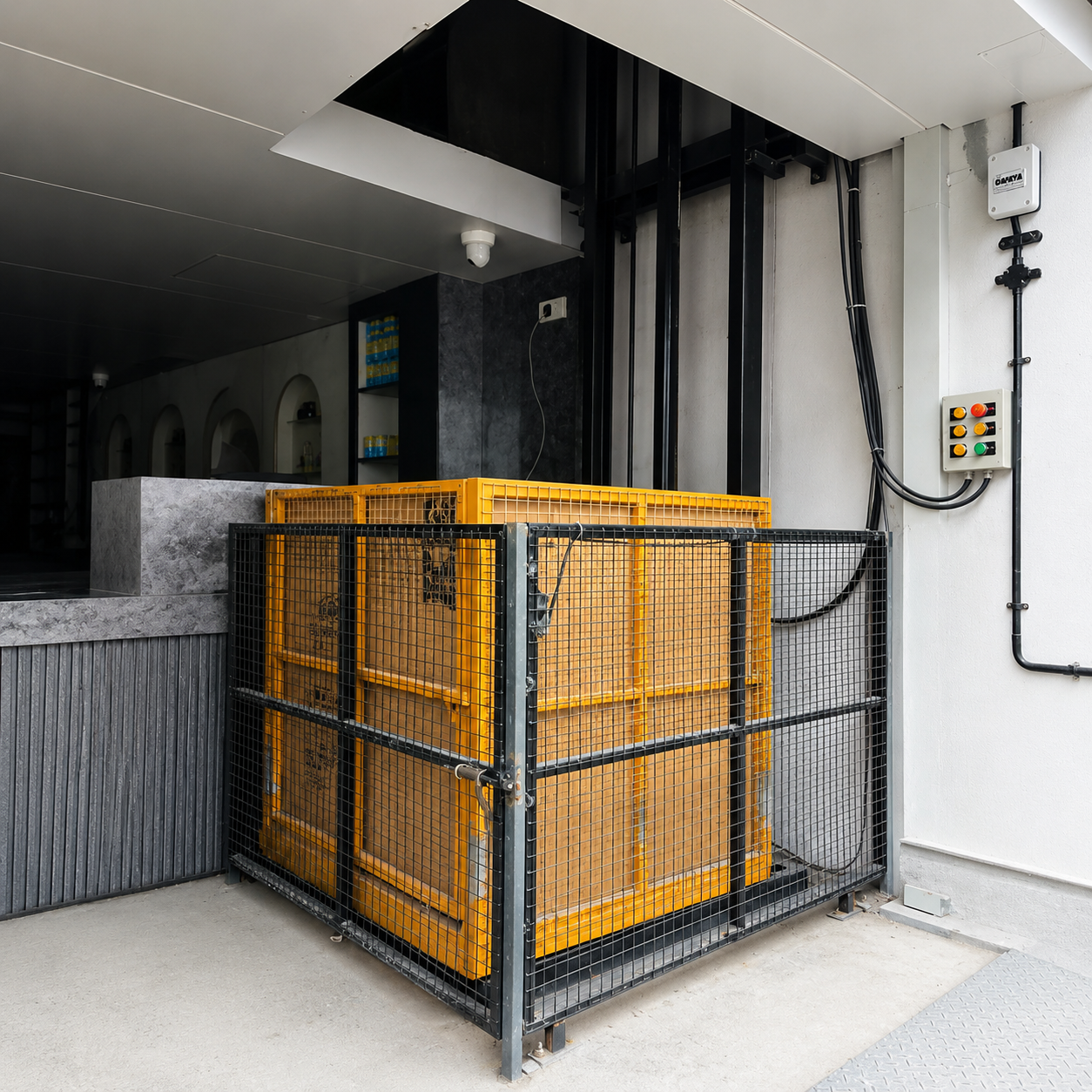


Contilift Equipment is Leading hydraulic goods lift manufacturers in Ahmedabad and material-handling equipment, supplying customized lifting solutions for industrial and commercial requirements in Ahmedabad and across Gujarat.
Our hydraulic goods lifts can be configured according to load capacity, platform dimensions, lifting height, number of stops, material type, operating frequency and available installation space. They are suitable for factories, warehouses, manufacturing units, automobile facilities, packaging units and other applications where goods need to be moved vertically between different levels.
For Ahmedabad projects, the requirement can be evaluated based on the site layout and material-handling application. Contilift Equipment handles product engineering and manufacturing from its Pune base, with delivery and project-specific installation or commissioning support arranged according to the project scope. The focus is on selecting the appropriate hydraulic goods lift configuration rather than using a standard lift specification for every application.
What is Hydraulic Goods Lift?
A Hydraulic Goods Lift is a robust lifting solution specially designed for transporting heavy materials safely between different floor levels. It operates using a hydraulic power system that provides smooth, stable, and controlled lifting performance even under demanding working conditions. Widely used across industrial and commercial sectors, these lifts improve material handling efficiency while reducing manual effort and workplace risks.
Our lifts are manufactured with high-quality components, advanced safety features, and customizable specifications to suit different applications. They are ideal for businesses seeking reliable, space-saving, and cost-effective lifting equipment for continuous daily operations.
How Hydraulic Goods Lift Works?
A hydraulic goods lift uses a hydraulic power unit and cylinder arrangement to raise and lower the platform in a controlled manner. The final system configuration depends on the load, travel, number of stops, platform dimensions, and site requirements.
- Loading the Goods: The operator carefully places the goods on the lift platform, ensuring the load is evenly distributed for safe and balanced lifting.
- Hydraulic Power Activation: The hydraulic power unit pumps hydraulic oil into the cylinder, creating the pressure required to lift the platform.
- Smooth Vertical Lifting: The hydraulic cylinder extends gradually, raising the platform in a controlled and jerk-free manner to the desired height.
- Stable Movement Control: Advanced control mechanisms maintain smooth, stable, and vibration-free operation throughout the lifting process.
- Accurate Floor Positioning: The lift stops precisely at the selected floor level, allowing safe and convenient loading or unloading of materials.
- Safety Lock Engagement: Built-in safety locking systems secure the platform firmly in place, preventing unintended movement during operation.
- Controlled Platform Lowering: After unloading, the hydraulic system releases pressure gradually, lowering the platform smoothly and safely for the next lifting cycle.
Types of Hydraulic Goods Lift
Contilift Equipment offers hydraulic goods lift solutions for industrial, commercial, warehouse, automotive, and material-handling applications. Different configurations use different support structures and lifting mechanisms, so the right choice depends on load capacity, lifting height, platform dimensions, load distribution, available space, and site installation conditions.
200–1,000 kg
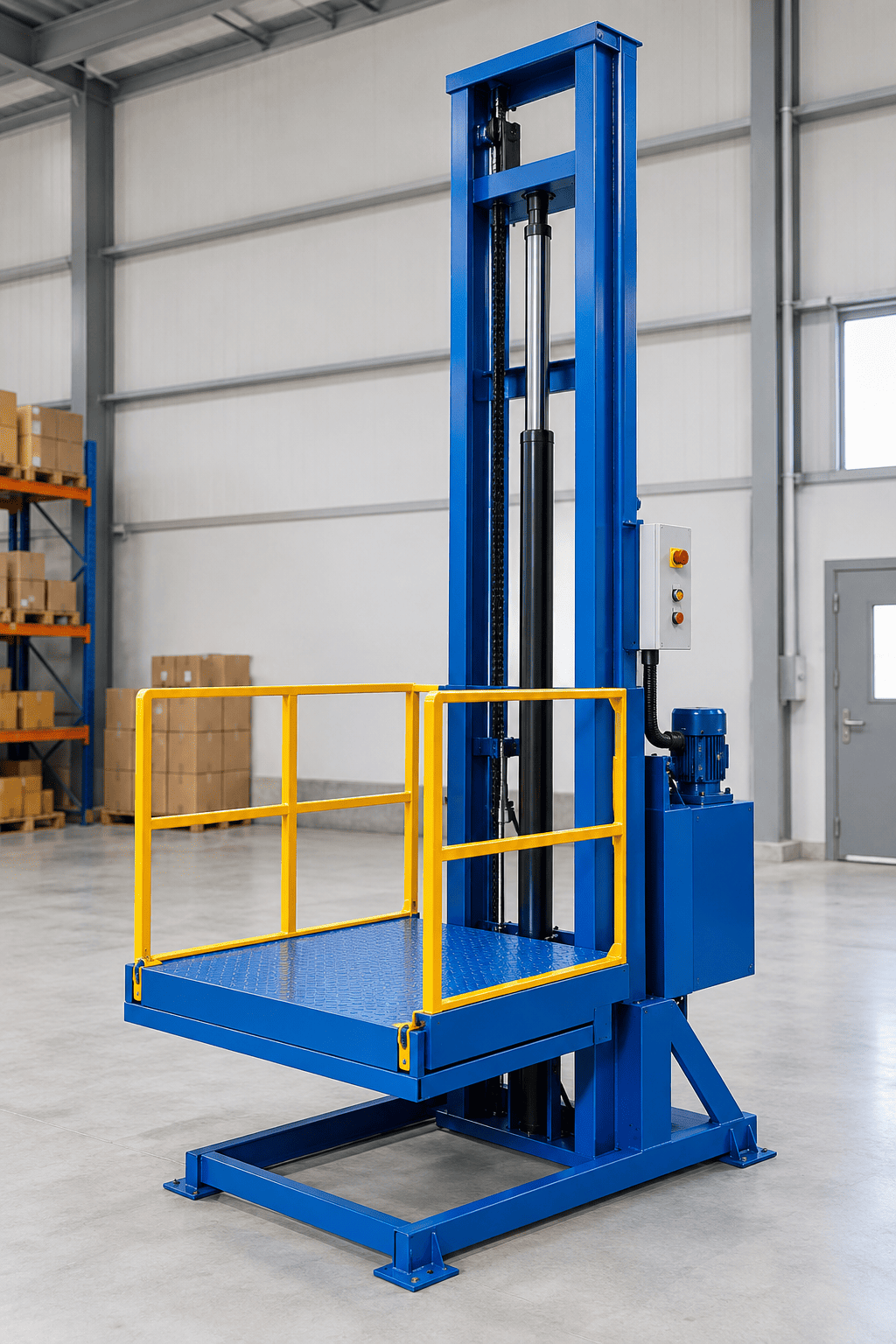
Single Mast Hydraulic Goods Lift
Uses a single main vertical support structure with a hydraulic lifting system. Its relatively compact layout can suit light to medium-duty goods handling where floor space is limited. Suitable for shops, stores, and small warehouses, subject to the specified load, platform size, travel height, and support requirements. The mast and its supporting structure must be designed for the actual load and any off-centre loading.
1,000–5,000 kg
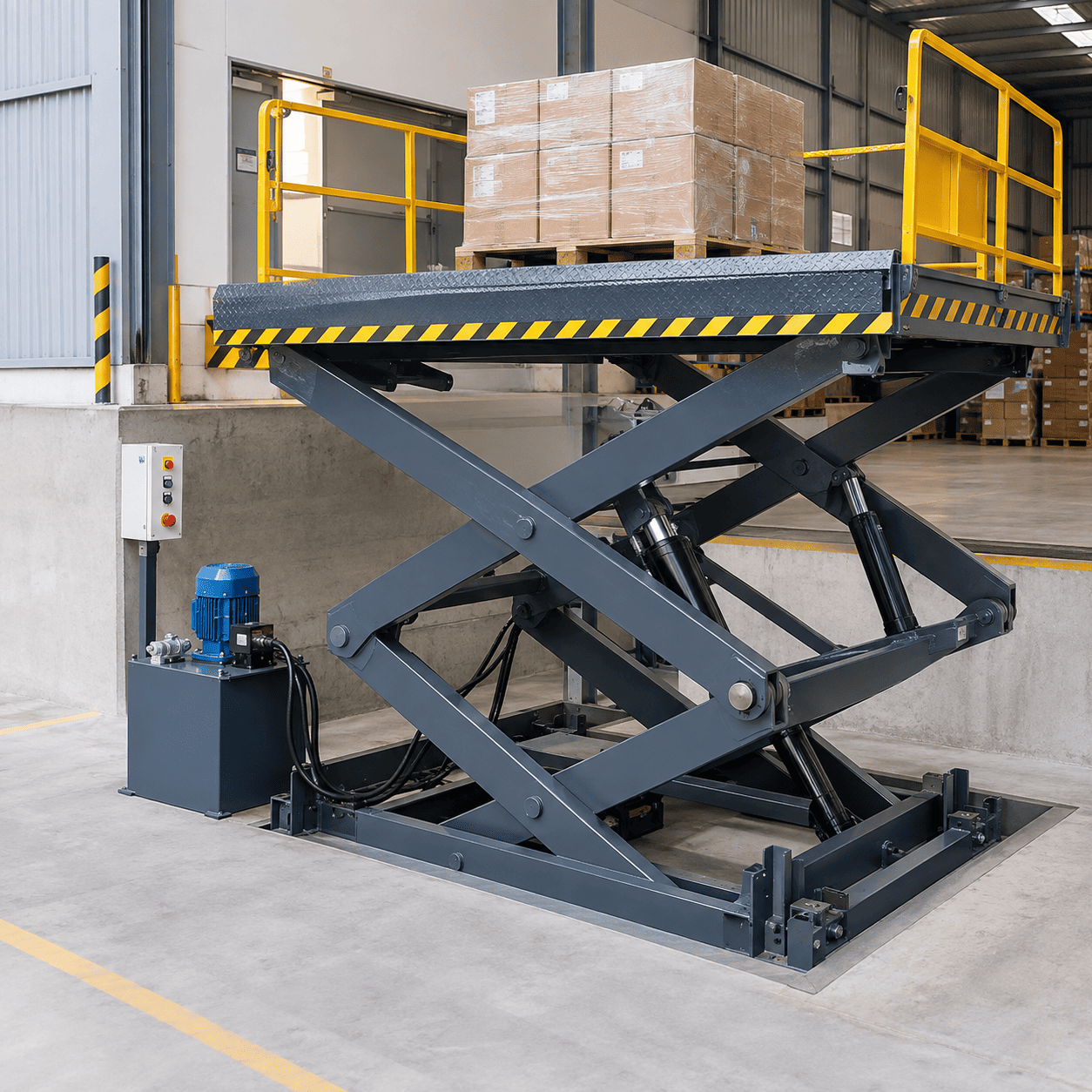
Dual Mast Hydraulic Goods Lift
Uses two vertical mast or guide-support structures to support and guide the lifting platform. Compared with a single-mast arrangement, a properly engineered dual-mast design can better accommodate wider platforms and distributed loads. It is suitable for factories, warehouses, and production facilities handling bulky or heavy goods. Installation requires adequate space for both supports and suitable floor, foundation, and structural anchorage. Actual capacity and stability depend on the complete lift design.
Capacity: Project-Specific
Center-Cylinder Hydraulic Goods Lift
Uses a centrally positioned hydraulic cylinder to raise the platform, with the platform guides and supporting structure carrying lateral forces and controlling movement. This arrangement can be suitable where a central lifting point fits the platform layout and load distribution. The cylinder, guide system, pit or base arrangement, and structural supports must be designed for the required load and travel height. It is not automatically suitable for every large or off-centre load.
500–5,000 kg
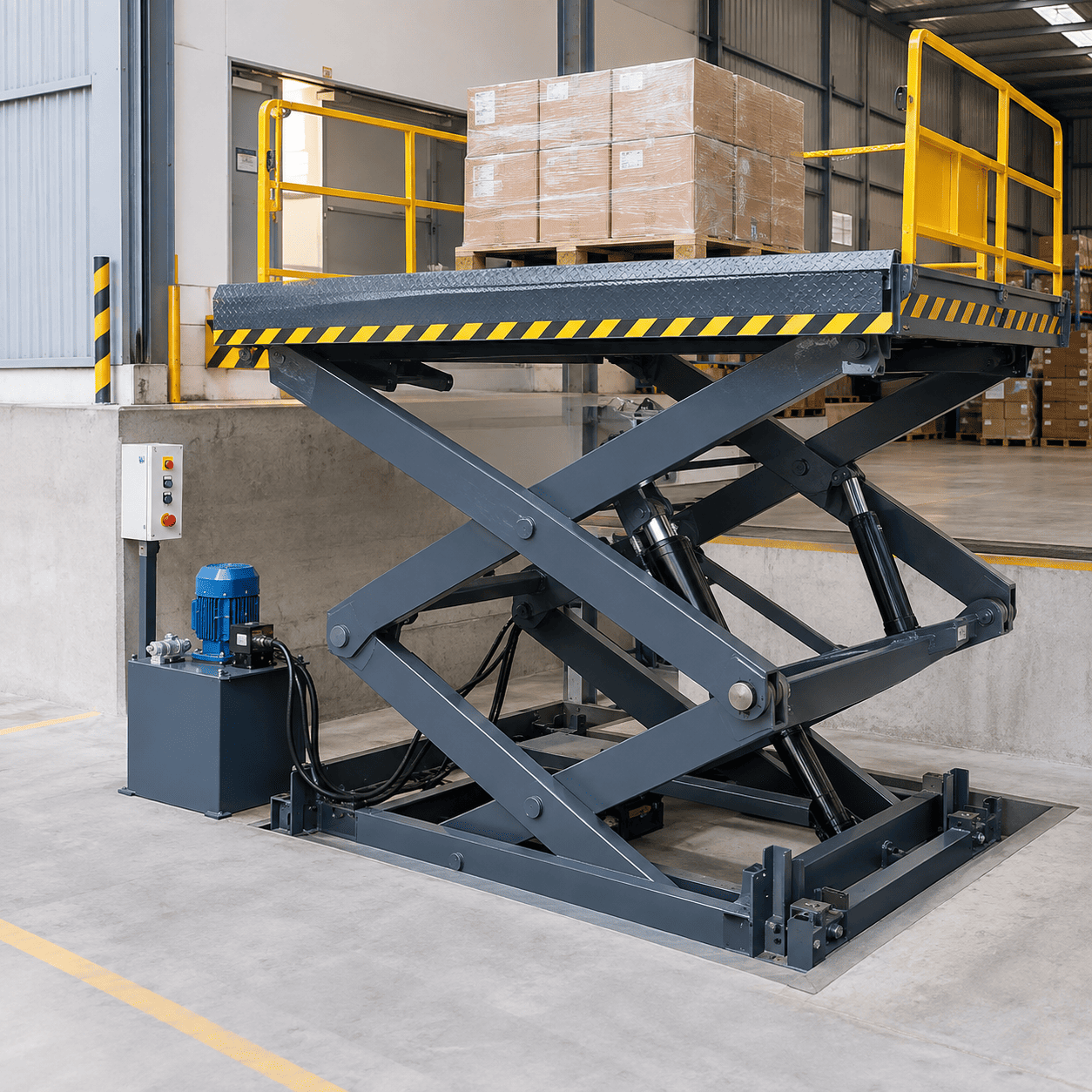
Hydraulic Scissor Goods Lift
Uses crossed scissor arms driven by a hydraulic cylinder to raise and lower the platform. It is useful for loading bays, workshops, production lines, and goods transfer between nearby working levels. Unlike mast-guided lifts, the scissor mechanism expands beneath the platform and needs sufficient room for its movement. A pit may be required for low-level access, depending on the closed height and installation design. Platform stability, load distribution, and maximum travel must be checked for each application.
500–3,000 kg
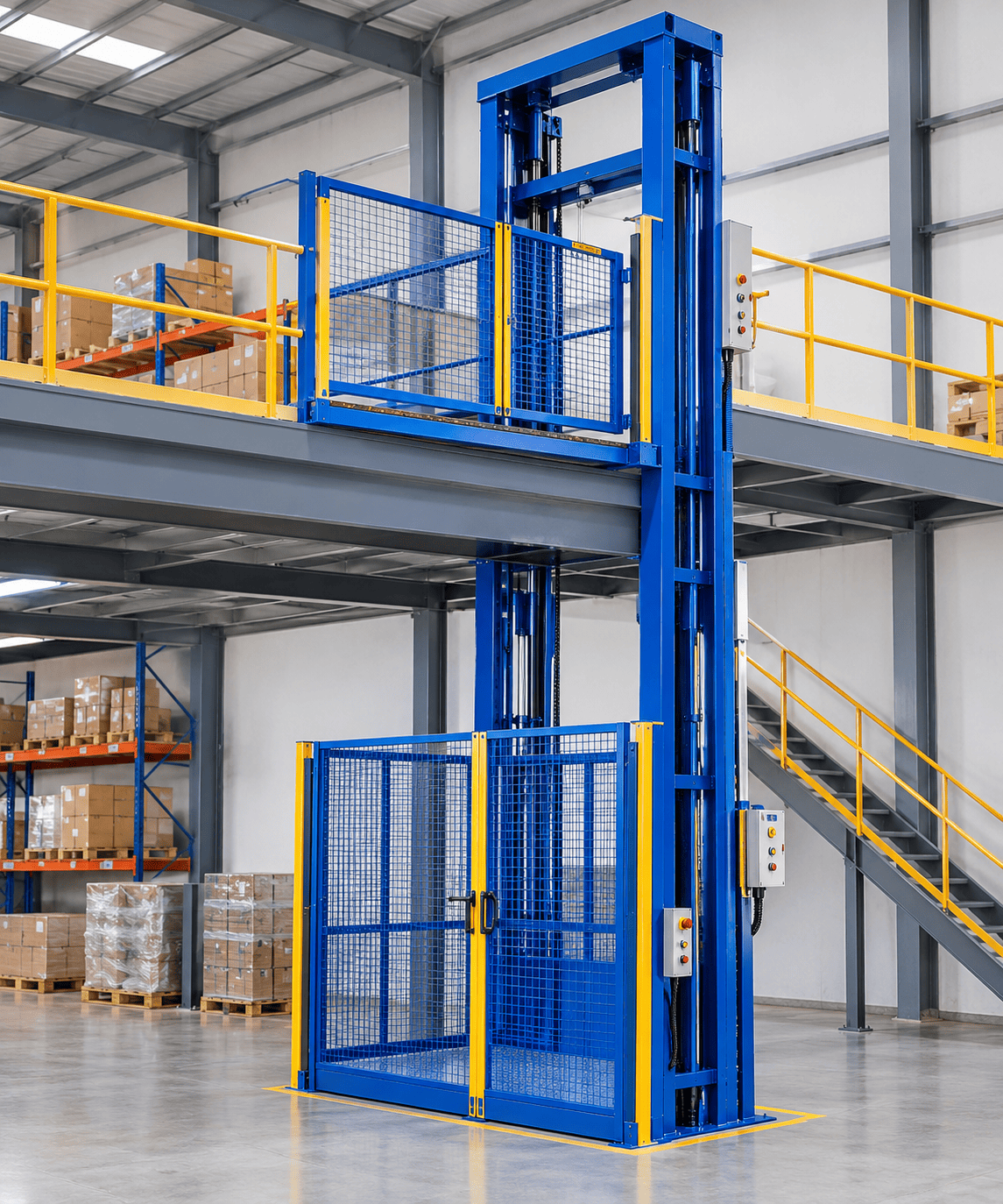
Mezzanine Lift (VRC)
A vertical reciprocating conveyor designed to move pallets, inventory, and other goods between floor levels, including mezzanines. The lifting mechanism and guide arrangement depend on the selected model. It is suitable for warehouses and industrial facilities requiring repeated vertical goods transfer. Installation must account for floor openings, structural support, landing access, guarding, and interlocked gates. A goods-only VRC is not intended to carry people unless specifically designed and approved for that purpose.
2,000–10,000 kg*
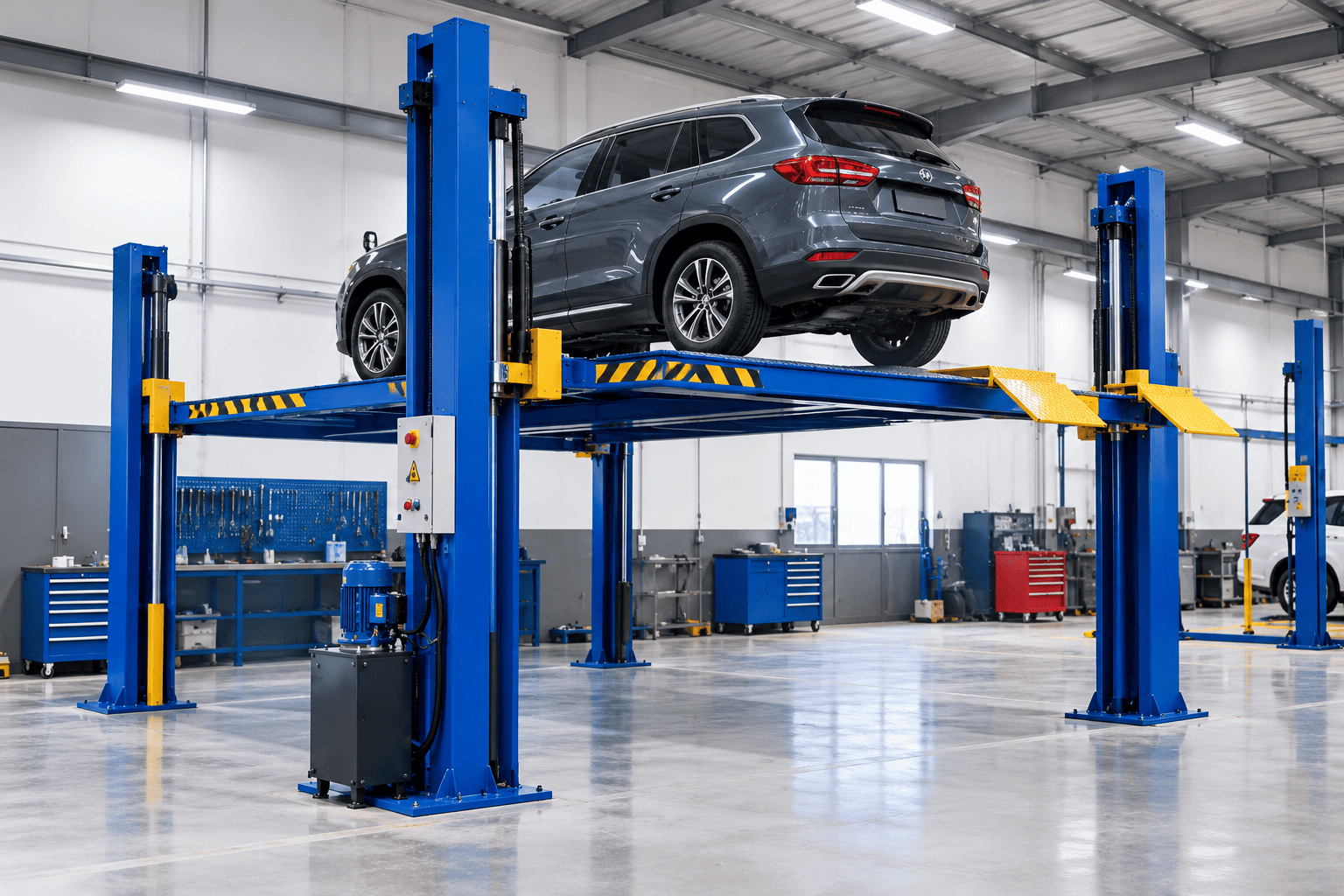
Automotive Hydraulic Lift
Configured for vehicles or automotive components, with the platform dimensions, support arrangement, and lifting system selected for the intended application. Suitable for workshops, service facilities, and vehicle-handling areas when engineered for the vehicle's weight, wheelbase, centre of gravity, and loading method. The installation must provide adequate foundation capacity, access clearance, vehicle restraint where required, and appropriate safety devices.
200–2,000 kg
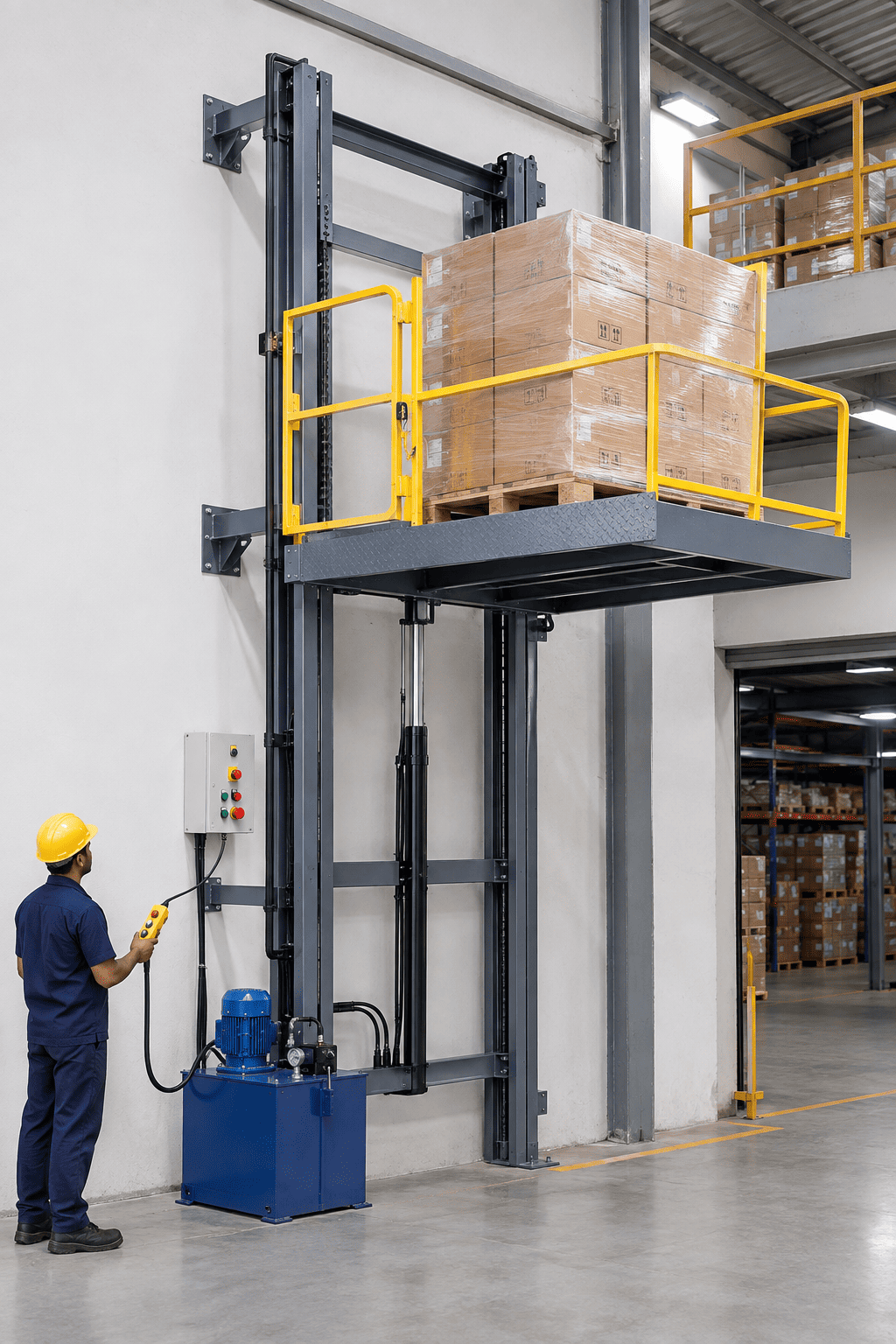
Wall-Mounted Hydraulic Goods Lift
Installed alongside a building wall, with the mounting and guide arrangement designed to transfer the lift's operating forces safely into the supporting structure. It can help conserve floor space in factories and commercial facilities. The existing wall must not be assumed suitable without structural assessment; adequate anchorage, foundation support, landing access, and clearance for the platform are essential. Where the wall cannot carry the required forces, an independent support frame may be necessary.
Note: Listed load capacities are indicative and must be verified against the actual product specifications. The final selection depends on rated load, load distribution, platform dimensions, lifting height, duty cycle, operating conditions, and installation constraints. Confirm available configurations, dimensions, and capacities with Contilift Equipment before ordering.
Technical Specifications of Hydraulic Goods Lifts
| Technical Parameter | Single Mast Hydraulic Goods Lift | Double Mast Hydraulic Goods Lift | Hydraulic Scissor Goods Lift | Mezzanine Lift (VRC) | Automotive Hydraulic Lift | Wall-Mounted Hydraulic Lift |
|---|---|---|---|---|---|---|
| Load Capacity | 200–1,000 kg | 1,000–5,000 kg | 500–5,000 kg | 500–3,000 kg | 2,000–10,000 kg* | 200–2,000 kg |
| Platform Size | 600 × 600 to 1,500 × 1,500 mm | 1,000 × 1,000 to 2,500 × 3,000 mm | 1,000 × 1,000 to 2,500 × 4,000 mm | 1,000 × 1,000 to 2,500 × 3,000 mm | 2,500 × 5,000 to 3,000 × 6,000 mm | 600 × 600 to 1,500 × 2,000 mm |
| Lifting Height / Travel | Up to 6 m | Up to 12 m | Up to 6 m | 3–15 m | 1.5–5 m | Up to 6 m |
| Mast / Column Arrangement | 1 mast | 2 masts | Scissor mechanism | 2 or 4 guides/columns | 2 or 4 columns | Wall-mounted guide structure |
| Drive System | Hydraulic power pack | Hydraulic power pack | Hydraulic power pack | Hydraulic power pack | Heavy-duty hydraulic system | Hydraulic power pack |
| Hydraulic Cylinder | Single hydraulic cylinder | Single/dual hydraulic cylinder arrangement | Hydraulic cylinder(s) | Hydraulic cylinder arrangement | Heavy-duty hydraulic cylinder(s) | Hydraulic cylinder |
| Guide System | MS/structural guide mast | Twin structural guide columns | Scissor arms with rollers | Guided carriage with structural columns | Heavy-duty guide columns | Wall-supported guide rails |
| Platform Construction | MS fabricated frame | Heavy-duty MS fabricated frame | Heavy-duty MS scissor frame | MS fabricated cage/platform | Heavy-duty structural steel | MS fabricated platform |
| Platform Deck | Chequered steel plate | Chequered steel plate | Chequered steel plate | Chequered steel plate | Anti-skid/chequered steel plate | Chequered steel plate |
| Motor Rating | Approx. 2–5 HP | Approx. 3–10 HP | Approx. 3–10 HP | Approx. 3–10 HP | Approx. 5–20 HP | Approx. 2–5 HP |
| Operating Speed | 3–6 m/min | 3–6 m/min | 2–6 m/min | 3–6 m/min | 2–5 m/min | 3–6 m/min |
| Power Supply | 415 V, 3 Phase, 50 Hz | 415 V, 3 Phase, 50 Hz | 415 V, 3 Phase, 50 Hz | 415 V, 3 Phase, 50 Hz | 415 V, 3 Phase, 50 Hz | 415 V, 3 Phase, 50 Hz |
| Control Voltage | 24 V DC / as required | 24 V DC / as required | 24 V DC / as required | 24 V DC / as required | 24 V DC / as required | 24 V DC / as required |
| Control System | Push-button / pendant / landing controls | Push-button / pendant / landing controls | Push-button / pendant / landing controls | Multi-level landing controls | Push-button / pendant / automatic controls | Push-button / pendant / landing controls |
| Safety Features | Emergency stop, overload protection, limit switches, safety railing | Overload protection, limit switches, safety system, enhanced stability | Hose-burst protection, mechanical locking arrangement, limit switches | Interlocked gates, limit switches, emergency stop | Mechanical locks, overload protection, emergency stop | Limit switches, emergency stop, safety gates |
| Landing Gates | Optional / application-specific | Required where applicable | Optional / required | Recommended/required at accessible levels | As per vehicle lift configuration | Required where applicable |
| Safety Enclosure | Optional | Optional / recommended | Optional | Recommended / required | Application-specific | Optional / recommended |
| Floor / Pit Requirement | Usually pitless | Pitless or pit installation | Usually pitless | Generally pitless | Pit or pitless depending on model | Minimal floor requirement |
| Installation Space | Low | Moderate | Moderate | Moderate | Large | Very low floor footprint |
| Typical Duty | Light/medium duty | Medium/heavy duty | Medium/heavy duty | Medium/heavy duty | Heavy duty | Light/medium duty |
| Cabin / Cage | Optional | Optional | Optional | Usually enclosed | Application-specific | Optional |
| Finish | Industrial enamel / powder coating | Industrial enamel / powder coating | Industrial enamel / powder coating | Industrial enamel / powder coating | Industrial heavy-duty coating | Industrial enamel / powder coating |
| Customization | High | High | High | High | Very high | High |
| Best Suited For | Shops, stores, small warehouses | Factories, warehouses, production units | Workshops, loading areas | Warehouses and mezzanine floors | Automobile workshops and service centers | Factories and restricted spaces |
Technical Specification Note: The specifications shown above are indicative and may vary according to the selected lift configuration, rated load, platform dimensions, lifting height, duty cycle, and installation conditions. Motor power, operating speed, hydraulic cylinder arrangement, structural supports, and safety provisions must be confirmed against the final equipment design. Foundation capacity, anchorage, floor openings, pit requirements, guarding, and landing gates must also be assessed for the specific site. Contact Contilift Equipment for verified model specifications and a project-specific quotation.
Key Features of Hydraulic Goods Lift
Hydraulic goods lifts can be configured with different structural, hydraulic, control, and safety arrangements according to the application. The final features should be selected from the project requirements and site conditions.
- Heavy-Duty Load Handling: Designed to handle different material loads with strong structural construction, stable lifting performance, and reliable operation for demanding industrial applications.
- Efficient Hydraulic Lifting System: Uses a hydraulic power pack and cylinder arrangement to provide smooth, controlled, and consistent lifting and lowering of goods between different levels.
- Multiple Lift Configurations: Available in Single Mast, Double Mast, Scissor, Mezzanine/VRC, Automotive, and Wall-Mounted configurations to suit different material handling requirements.
- Customized Platform Design: Platform dimensions, load capacity, lifting height, enclosure, landing gates, and control arrangements can be customized according to site conditions and application needs.
- Reliable Safety Features: Depending on the configuration, the lift can include overload protection, emergency stop, limit switches, mechanical locking arrangements, safety gates, and hose-burst protection.
- Space-Saving Installation Options: Pitless, wall-mounted, and compact configurations are available for facilities where floor space or conventional pit installation is limited.
- Multi-Level Material Movement: Suitable for transferring goods, pallets, equipment, and industrial materials between ground floors, mezzanine levels, and other working heights.
- Durable Steel Construction: Manufactured using MS and structural steel components with robust platforms and guide arrangements for dependable performance in industrial environments.
- Flexible Control Systems: Push-button, pendant, and landing-level controls can be provided based on the lift configuration and operational requirements.
- Wide Range of Applications: Suitable for warehouses, factories, workshops, production units, loading areas, commercial facilities, automobile workshops, and other material handling environments.
Benefits of Hydraulic Goods Lift
Hydraulic Goods Lifts provide a practical and reliable solution for moving heavy materials between different working levels. Their hydraulic operation, strong construction, and flexible configurations help improve material handling efficiency while reducing manual lifting requirements.
- Efficient Material Handling: Enables smooth movement of goods, pallets, equipment, and other materials between floors, mezzanine levels, and loading areas.
- Reduces Manual Handling: Minimizes the need for manual lifting and carrying of heavy materials, helping improve workplace productivity and handling convenience.
- Handles Heavy Loads: Available in different capacities and configurations to support light, medium, and heavy-duty material handling requirements.
- Smooth and Controlled Operation: Hydraulic lifting technology provides controlled raising and lowering of the platform for dependable goods transportation.
- Space-Saving Installation: Compact, pitless, and wall-mounted options can be selected for facilities where installation space is limited.
- Improves Operational Productivity: Reduces the time and effort required to transfer materials between different levels, helping streamline industrial workflows.
- Flexible Application Options: Suitable for warehouses, factories, production units, workshops, commercial facilities, loading areas, and automotive applications.
- Customizable to Site Requirements: Load capacity, platform size, lifting height, controls, gates, enclosure, and other features can be configured according to the application.
- Enhanced Workplace Safety: Safety provisions such as limit switches, emergency stop systems, overload protection, mechanical locks, and safety gates can be incorporated based on the lift configuration.
- Durable and Long-Lasting Construction: Robust structural steel fabrication and industrial-grade components provide dependable performance for regular material handling operations.
How to Choose the Right Hydraulic Goods Lift for Your Application?
Choosing the right Hydraulic Goods Lift requires careful consideration of your material-handling requirements, site conditions, and daily operating needs. Factors such as load capacity, platform dimensions, lifting height, number of stops, type of goods, operating frequency, and available installation space determine the most suitable hydraulic lifting system for your facility. A properly selected goods lift provides safe, controlled, and efficient vertical transportation of materials between different levels.
- Determine the Required Load Capacity: Identify the maximum weight of materials that the goods lifting equipment will need to carry. Light and medium-duty applications may require lower capacities, while factories, warehouses, and heavy industrial operations may need higher-capacity hydraulic lifts for demanding material-handling conditions.
- Select the Appropriate Platform Size: Choose platform dimensions according to the size, shape, and quantity of goods being transported. Pallets, machinery parts, cartons, boxes, and bulky components may require a wider or longer platform for safe loading, unloading, and positioning.
- Consider the Required Lifting Height: Determine the vertical distance between the loading and unloading levels. The required travel height helps establish the appropriate configuration of the hydraulic material handling lift and its supporting structure.
- Check the Number of Floors or Stops: For multi-level material movement, consider the number of floors or landing points that require access. Such applications may require suitable landing gates, controls, limit switches, and safety arrangements at each accessible level.
- Evaluate the Type of Goods: Consider whether the lift will transport pallets, raw materials, finished products, machinery components, cartons, automotive parts, or other industrial goods. The size, weight, shape, and handling method of the materials can influence the lift design and platform configuration.
- Assess the Operating Frequency: Determine how frequently the lifting equipment will be used during a typical working day. Applications involving frequent or repetitive material movement may require a robust industrial goods lift designed for regular-duty operation.
- Evaluate Available Installation Space: Review the available floor area, installation height, access points, and surrounding structure before selecting a lift. Depending on the site, configurations such as single mast, double mast, scissor, mezzanine, or wall-mounted hydraulic lifts may be suitable.
- Review Safety Requirements: Safety should be an important consideration when selecting lifting equipment. Depending on the application, the system may include emergency stop controls, overload protection, limit switches, safety locks, landing gates, and other suitable safety mechanisms.
- Consider Loading and Unloading Conditions: Examine how materials will be moved onto and off the platform. Pallet trucks, trolleys, forklifts, carts, and manual loading methods may require different platform arrangements and landing access configurations.
- Plan for Application-Specific Customization: Different facilities have different material-handling requirements. A hydraulic goods lifting system can be customized according to load capacity, platform dimensions, lifting height, number of stops, gate arrangement, installation conditions, and other project-specific requirements.
Main Components of a Hydraulic Goods Lift
A hydraulic goods lift combines structural, hydraulic, electrical, and safety components. The exact component selection varies with the lift configuration and project requirements.
- Hydraulic Power Unit: Provides the hydraulic pressure required for lifting and lowering the platform.
- Hydraulic Cylinder: Converts hydraulic pressure into the lifting movement of the platform.
- Platform: Sized according to the load, material dimensions, loading method, and available space.
- Guide Structure: Supports and guides the platform during vertical movement.
- Control System: Provides push-button, pendant, landing, or other controls according to the selected configuration.
- Landing Gates and Enclosure: Provided where required by the application and access arrangement.
- Safety Devices: May include limit switches, emergency stop, overload protection, mechanical locks, hose-burst protection, and other application-specific provisions.
- Hydraulic Hoses and Valves: Control hydraulic flow and support controlled lifting and lowering operation.
Hydraulic Goods Lift Selection Guide
| Application Requirement | Key Selection Considerations | Suitable Lift Configuration |
|---|---|---|
| Light to medium material handling | Moderate load capacity with limited installation space | Single Mast Hydraulic Goods Lift |
| Heavy industrial material handling | Higher load capacity, larger platform, and enhanced structural stability | Double Mast Hydraulic Goods Lift |
| Workshops and loading areas | Stable vertical movement between different working heights | Hydraulic Scissor Goods Lift |
| Warehouse and mezzanine applications | Movement of pallets, inventory, and goods between storage levels | Mezzanine Lift / VRC |
| Automotive material handling | Large platform requirements and heavy vehicle or component loads | Automotive Hydraulic Lift |
| Space-restricted installations | Minimal floor footprint and wall-supported installation requirements | Wall-Mounted Hydraulic Lift |
Before selecting a Hydraulic Goods Lift, provide details such as required load capacity, platform dimensions, lifting height, number of stops, type of materials, installation location, operating frequency, and available space. These specifications help determine the appropriate hydraulic lifting equipment and allow the lift configuration to be developed according to the actual application requirements.
Whether the requirement is for a factory, warehouse, manufacturing unit, automobile workshop, commercial facility, or storage area, selecting the right goods lift system according to the actual site and material-handling conditions can improve operational efficiency and provide dependable vertical transportation of goods.
Information Required for a Hydraulic Goods Lift Quotation
For a more accurate quotation, share the following project details wherever available:
- Required load capacity: Maximum weight to be lifted.
- Platform dimensions: Required length and width based on the goods or pallet size.
- Lifting height: Vertical travel from the lowest to the highest loading level.
- Number of stops: Floors or landing levels that require access.
- Goods and loading method: Pallets, cartons, machinery, components, trolleys, pallet trucks, forklifts, or manual loading.
- Operating frequency: Expected lifting cycles or usage during the working day.
- Available installation space: Floor area, headroom, access, and surrounding structure.
- Pit or pitless requirement: Existing pit availability or preference for a pitless arrangement.
- Site information: Drawings, photographs, layout details, or dimensions can help with technical evaluation.
Hydraulic Goods Lift Installation Requirements
Installation requirements vary by configuration. Before finalizing the lift, the project should be checked for platform location, structural support, landing access, available headroom, pit or pitless arrangement, power supply, gate positions, loading space, and the location of the hydraulic power unit. Site-specific civil or structural work, where required, should be identified before installation.
Hydraulic Goods Lift vs VRC
| Consideration | Hydraulic Goods Lift | VRC / Mezzanine Lift |
|---|---|---|
| Typical use | Vertical movement of goods between defined levels using a hydraulic lifting system. | Vertical movement of pallets, inventory, and goods between storage or mezzanine levels. |
| Drive arrangement | Hydraulic power unit and cylinder arrangement. | Configuration depends on the selected VRC design. |
| Platform / carriage | Can be configured according to load and material-handling requirements. | Generally selected around pallet, inventory, and mezzanine-transfer requirements. |
| Best selection basis | Load, travel, stops, platform, loading method, and site conditions. | Goods type, storage levels, platform size, travel, access, and site layout. |
Ahmedabad Project Support for Hydraulic Goods Lifts
For hydraulic goods lift requirements in Ahmedabad and across Gujarat, the configuration is evaluated according to the application, site conditions, and material-handling requirements. Contilift Equipment manages product engineering and manufacturing from its Pune base, with delivery and additional project support arranged according to the agreed scope.
- Requirement Assessment: Review the required load capacity, platform dimensions, lifting height, number of stops, goods type, loading method, and operating frequency.
- Configuration Selection: Identify a suitable lift arrangement based on the application, available space, travel requirements, and site conditions.
- Technical Planning: Evaluate the platform layout, hydraulic system, guide structure, controls, landing gates, safety provisions, and installation requirements.
- Manufacturing and Delivery: Product engineering and manufacturing are handled from Pune, with delivery to Ahmedabad arranged according to the project schedule.
- Installation and Commissioning: Installation, testing, commissioning, and technical support can be discussed and arranged according to the agreed project scope and site readiness.
To assess your requirement, share the site layout or drawings along with the required capacity, lifting height, platform size, and number of stops.
Applications of Hydraulic Goods Lift
Hydraulic goods lifts can be used in factories, warehouses, production units, workshops, commercial facilities, packaging operations, and other locations where goods need to be moved vertically between working levels. The final configuration should be selected according to the actual material, load, travel, and site conditions.
- Factories and Manufacturing Units: Ideal for transporting raw materials, machinery parts, components, tools, and finished products between different floors of manufacturing facilities, helping streamline internal material handling.
- Warehouses and Storage Facilities: Suitable for lifting pallets, cartons, boxes, packaged products, raw materials, and other inventory between storage levels while reducing manual handling and improving operational efficiency.
- Commercial Buildings and Shopping Malls: Useful for moving merchandise, equipment, supplies, maintenance materials, and other heavy goods between floors, supporting smooth day-to-day operations.
- Automobile Workshops: A hydraulic goods lift can be integrated with a Hydraulic Stacker Lift or other material-handling equipment to efficiently move engines, vehicle components, tools, spare parts, and workshop equipment.
- Hotels and Restaurants: Helps transport kitchen supplies, food ingredients, beverages, utensils, housekeeping materials, equipment, and other essential goods between floors with greater convenience.
- Pharmaceutical and Food Industries: Suitable for the controlled and organized movement of raw materials, packaged products, ingredients, and finished goods between production, processing, and storage areas.
- Packaging and Printing Industries: Efficiently handles paper rolls, packaging materials, printing supplies, machinery components, and finished products between different production and storage levels.
- Logistics and Distribution Centers: Well suited for warehouses, loading and unloading areas, container-handling operations, and distribution facilities where frequent vertical movement of goods is required. It helps improve workflow while reducing the need for manual lifting.
A hydraulic goods lift is an effective solution for businesses looking to improve vertical material transportation, minimize manual handling, and maintain a safer and more efficient workplace. Its applications can be customized according to lifting capacity, platform dimensions, number of floors, and the specific operational requirements of the facility.
Why Choose Contilift Equipment?
- Pune-Based Manufacturing: Contilift Equipment manufactures hydraulic goods lifts from its Pune base and supplies lifting solutions for projects in Ahmedabad and across Gujarat.
- Application-Specific Configuration: Lift selection is based on load capacity, platform dimensions, lifting height, number of stops, material type, operating frequency, loading method, and available installation space.
- Multiple Configurations: Single mast, double mast, scissor, mezzanine/VRC, automotive, and wall-mounted options are available according to the application.
- Technical Support: Project-specific technical evaluation, configuration guidance, delivery, and installation or commissioning support can be arranged according to the agreed scope.
- Ahmedabad and Gujarat Supply: The page is intended for projects in Ahmedabad while the actual manufacturing base remains in Pune, keeping the location and service arrangement transparent.
For a suitable hydraulic goods lift, share the required load, platform size, lifting height, number of stops, material-handling method, and available site details. The final configuration and project scope can then be determined according to the application.
Contact Contilift Equipment to discuss your hydraulic goods lift requirement for Ahmedabad or another location in Gujarat.
Frequently Asked Questions
Yes. Contilift Equipment is based in Pune and supplies hydraulic goods lifts for projects in Ahmedabad and across Gujarat. Delivery and project-specific installation, testing, commissioning, or technical support can be arranged according to the agreed scope.
The price depends on load capacity, platform size, lifting height, number of stops, hydraulic system, safety provisions, installation requirements, and customization. A project-specific quotation can be prepared after reviewing the required specifications.
Capacity varies by configuration. The indicative table on this page shows different ranges for single mast, double mast, scissor, mezzanine/VRC, automotive, and wall-mounted configurations. The final capacity must be selected according to the actual application.
Share the required load capacity, platform dimensions, lifting height, number of stops, type and size of goods, loading method, operating frequency, installation location, available space, and site drawings or photographs where available.
Yes. Depending on the configuration, the platform, capacity, travel, number of stops, gates, enclosure, controls, and other application-specific features can be configured around the project requirements.
Some configurations can be designed as pitless installations. The feasibility depends on the selected lift, platform arrangement, travel, site conditions, loading levels, and required structural provisions.
A hydraulic goods lift uses a hydraulic power unit and cylinder arrangement for lifting. A VRC or mezzanine lift is generally selected for vertical movement of goods between storage or mezzanine levels. The appropriate choice depends on the goods, travel, platform, access, and site layout.
The hydraulic power unit generates pressure and supplies hydraulic fluid to the cylinder arrangement. The cylinder moves the platform vertically, while the guide structure, controls, and safety devices support controlled operation.
Yes. Hydraulic goods lifts can be configured for factories, warehouses, production units, workshops, packaging operations, and other facilities where materials need to move between different levels.
It may be possible depending on the available floor area, structural conditions, lifting height, landing access, headroom, pit or pitless arrangement, and other site requirements. Site details should be evaluated before finalizing the configuration.
Depending on the configuration, safety provisions can include emergency stop, overload protection, limit switches, mechanical locking arrangements, landing gates, safety enclosures, and hose-burst protection.
Space requirements depend on platform dimensions, travel, number of stops, landing arrangement, guide structure, gates, and the selected configuration. Exact dimensions should be confirmed from the project layout.
Maintenance can include inspection of hydraulic oil, power unit, hoses, cylinder, seals, electrical components, controls, gates, limit switches, and safety devices. The maintenance schedule should follow the equipment and project requirements.
Installation time depends on the lift configuration, travel, number of stops, site readiness, structural or civil work, and customization. A project-specific schedule can be discussed after the site and technical requirements are evaluated.
Share the required capacity, platform size, lifting height, number of stops, goods details, loading method, site location, and available drawings or photographs. Contilift Equipment can then review the requirement and discuss a suitable configuration and quotation.